4
Pian di Spagna – Colico

Stories of migration and trade at the gateway to Valtellina

Harmony and beauty, where everything flows

The essence of life lies in its constant, undaunted, tireless flow. Everything moves and shifts, blends and evolves. It is in the nature of things, of animals and of people. The Pian di Spagna has witnessed stories of transit, of domination and of encounter. A landscape that became a passage for animals and peoples, merchants, armies and pilgrims. In this strategic area between Como and Sondrio, in the seventeenth century – during the Spanish domination of the Duchy of Milan – camps and fortifications were established. A military presence that left its mark, so much so that it found its way into I Promessi Sposi (The Betrothed), where Manzoni described the hardships of the local inhabitants, victims of abuse and raids.

Today the Pian di Spagna is a protected nature reserve, where flora and fauna coexist in a precious habitat: a resting point for migrating birds and a natural corridor between lake and mountain. Walking through these places, one feels a sense of movement and continuity, a synchrony between nature and history. In the awareness that every land is made of what passes through it, and of what remains.

Location
Pian di Spagna
Valtellina PDO & PGI Station

Ristorante La Trela

Via Mario Copes, 397
23020 Verceia

Ristorante Tennis & Gourmet Morbegno

Via Gregorini, 89
23017 Morbegno

Bites of Valtellina Flavours

Shape and substance

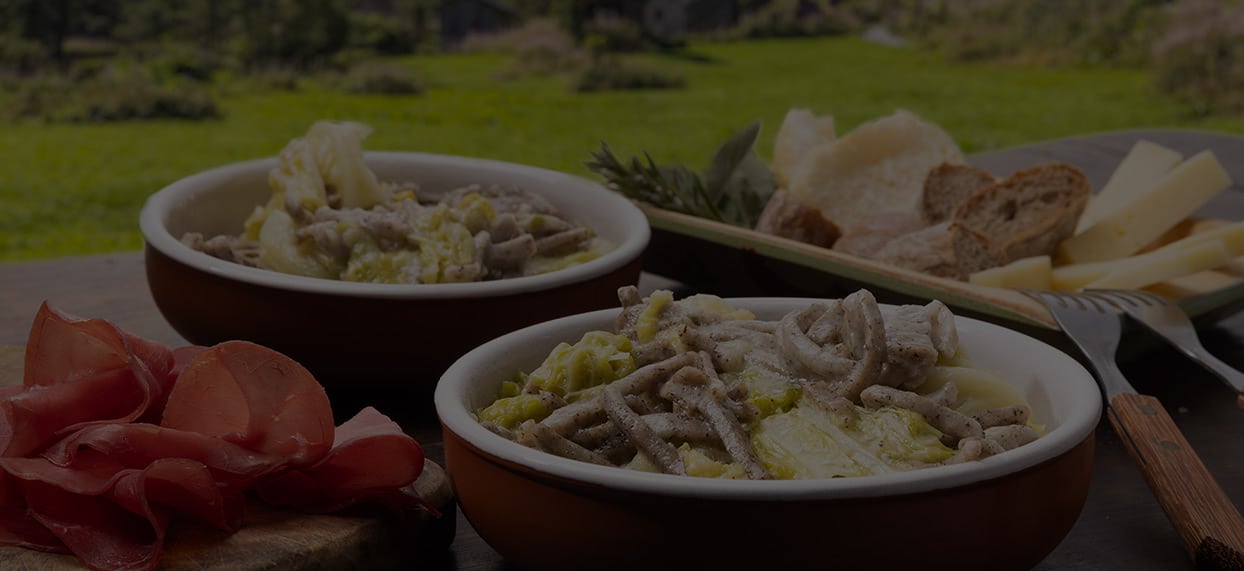
The PGI recognition applies to pasta produced by certified manufacturers following the official production specifications. Valtellina Pizzoccheri PGI can be tagliatello steso (flat strip), tagliatello avvolto (rolled strip) or gnocchetto (small dumpling). To make homemade pizzoccheri, the dough is cut by hand, meaning each piece may have a different, irregular shape.